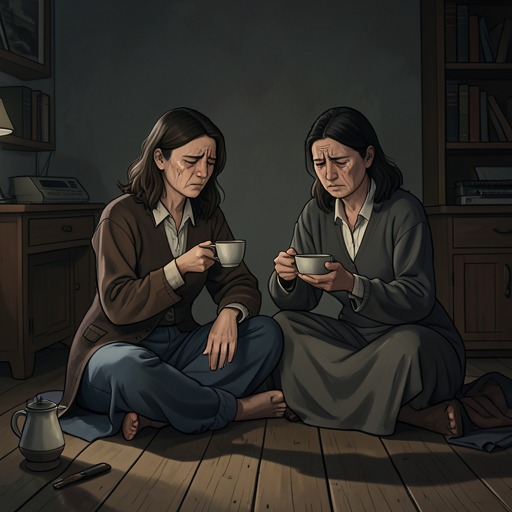
Amaia Salazar—Engrasi
Legado en los huesosAmaia Salazar—Engrasi is a relationship of kinship, refuge, and care: Engrasi is the aunt with whom Amaia lived from the age of nine until she left Elizondo, and whose home remains a place where Amaia can return, be welcomed, and face questions she cannot settle alone. Their closeness appears in ordinary domestic gestures as much as in conversations about the dead and the unexplained. Engrasi’s care is warm but not passive; she watches over Amaia, challenges the conclusions she reaches in distress, and leaves her with room to think.
Shared Home and Return
On returning to Engrasi’s house, Amaia finds her aunt seated by the fireplace, greeting her from the sitting room. Amaia asks her not to get up, approaches to kiss her, and asks how she is. Engrasi jokes about the dressing gown she is wearing; Amaia answers that, to her, Engrasi is always beautiful. Engrasi embraces her. The small exchange gives their affection a familiar, unceremonious form: tenderness expressed through teasing, reassurance, and touch.
The house itself carries the history of their relationship. Amaia recognizes her surroundings whenever she comes back, a gesture that feels to her like confirming both that she has arrived and that she has returned. She no longer tries to explain why she feels this way there; she lets herself enjoy it. Because she lived with Engrasi during her years in Elizondo, homecoming is not merely a visit to a relative. It reconnects Amaia with a place where she was raised and where her aunt’s presence still makes belonging tangible.
Care Across Generations
Their bond extends into Amaia’s life as a mother. When she asks about Ibai, Engrasi can tell her that he is asleep: James gave him a bottle about half an hour earlier and took him upstairs, apparently falling asleep beside him. A baby monitor sits on Engrasi’s wooden table. The details place her within the household’s daily network of care, attentive to the baby and able to reassure Amaia about what has happened while she was away.
That support matters against Amaia’s strain as a new mother. After waking from a confusing dream, she finds Ibai stretched across the bed and James left with little room. She lies briefly beside her son, whose peaceful sleep restores her sense of balance. When he wakes hungry and reaches for her breast, which can no longer feed him, she hands him to James and thinks of herself as a terrible mother. Earlier, after Amaia falls asleep on the sofa, Engrasi has covered her with a blanket and placed a cushion beneath her. The care is quiet and practical: Engrasi attends to Amaia even when Amaia is too exhausted to ask.
Counsel, Belief, and Boundaries
Engrasi’s support does not mean that she simply confirms Amaia’s fears. In another late return, she has been waiting by the fire, as she used to when Amaia was a teenager. Amaia kisses her forehead, then learns that Engrasi had been asleep. Engrasi tells her that anxiety keeps her awake while Amaia is out, and says that Amaia has fallen into the same pattern again. Her words make clear that she is concerned about the demands of Amaia’s work and about the way those demands draw her toward experiences beyond what others consider normal.
Amaia insists that only a particular man can help her, explaining that she has been to San Sebastián and found the grave empty. Engrasi does not accept that this makes the man indispensable. Instead, she asks whether he told Amaia anything she did not already know, and urges her to consider the question. The exchange shows a limit as well as a bond: Engrasi cannot resolve Amaia’s uncertainty for her, but she can resist the certainty that distress seems to impose and redirect her toward reflection.
The Tarot and the Unanswered Question
The women also share a more ritualized form of attention. After Ros and James have left, Engrasi and Amaia sit opposite each other in silence while Engrasi slowly unwraps a silk bundle containing the tarot deck and shuffles the cards between her fingers. Engrasi says she is glad Amaia has decided to face what is happening and reports that, for weeks, she has sensed energy flowing toward her whenever she takes up the cards. Amaia’s request to Ros, she explains, was only an excuse to talk with Engrasi about events at the bakery. The ritual thus becomes a setting for a conversation that Amaia has been approaching indirectly.
Later, after walking Engrasi upstairs, Amaia asks whether the dead can do anything. Engrasi answers that the dead do what they can. The response neither explains the empty grave nor promises that the dead will intervene. It gives Amaia a spare, bounded answer, one that acknowledges possibility without offering certainty. Their relationship’s distinctive balance appears again: Engrasi stays close to Amaia’s questions, but does not pretend to possess a solution.
The Relationship’s Significance
Across these moments, Engrasi’s role combines domestic constancy with moral and emotional counsel. She welcomes Amaia back into the house where she grew up, helps sustain the household around Ibai, notices when Amaia is exhausted, and worries when her work carries her into danger or uncertainty. Amaia, in turn, responds with affection and trusts Engrasi with questions she finds difficult to voice elsewhere. Their intimacy is not built on agreement about every matter; it is sustained by the fact that Amaia can return, speak, and be challenged without losing her place in Engrasi’s care.